
Imagine an agent processing a new support ticket. It needs to decide whether the ticket belongs in billing, security, product support, or general help. A typical prompt might ask the model to read the ticket, explain its reasoning, and recommend a destination. More advanced workflows might return all of that as structured JSON to make it easier to consume. A large language model can easily process the request and generate a detailed response.
That works, but most of the response is never used. The model spends time generating the output – one token at a time. It has to iterate through its calculations once for each output token, spending time and compute resources on content that will ultimately be discarded.
Compare that to a classic machine learning model. It takes in a series of inputs and produces a fixed set of outputs, such as probabilities for each item or specific labels. The computation is focused on evaluating the likelihood of each outcome rather than generating a long sequence of tokens. As a result, the math is much faster. A simple, task-specific classifier may struggle with complex text and the nuances that a language model can capture.
A constrained decision changes the approach: instead of an open-ended text-based response, it is constrained to specific outcomes. Like the classic models, it produces a fixed set of outputs, but it leverages the language model’s understanding of a prompt. That architectural change can make AI-powered decisions faster, easier to integrate, and simpler to operate.
Recent models such as Jev use this principle. They pair a language model’s ability to understand complex inputs with a classifier that chooses among a defined set of outcomes. Because the system does not need to generate an arbitrary sequence of output tokens, it can operate more efficiently. Let’s explore how this works.
A modern interpreter with a classic contract
At a high level, the language model interprets the context, then a trained classifier scores each allowed answer. For each potential answer, the model processes the context with that answer presented as a candidate. The classifier scores how well the candidate fits, so the system can compare options without generating a natural-language response.
This approach pairs the language model’s ability to understand ambiguous, unstructured language with the simplicity and speed of a classifier. For example, it can recognize that “I was charged again after canceling” concerns billing even when the ticket never uses the word billing. You get the best of both worlds.
To make a decision, a request gives the model three things:
- State
- The text and structured context needed to understand the situation, such as a ticket, account status, recent events, or policy details.
- Instructions
- The question the model needs to answer, such as which category best fits the request.
- Criteria
- The allowed answers, each with a description of what it means.
For each separate candidate answer, the model considers the same state and instructions with that answer presented as a candidate. The classifier scores how well it fits. For a bounded choice, the system converts the scores across all candidates into probabilities and selects the highest-scoring option. It does this without generating a yes-or-no token.
How would we do this? One way is to evaluate each possible answer as a candidate. At the application level, you might describe the decision like this:
 1{
 2  "state": "I was charged again after canceling",
 3  "questions": {
 4    "destination": {
 5      "instructions": "Which category best fits this request?",
 6      "type": "choice",
 7      "criteria": {
 8        "billing": "Issues related to purchases and payments, including refunds and charges",
 9        "security": "Issues related to account security, including passwords, access control, and unauthorized activity",
10        "support": "Issues requiring customer support, such as account problems or service inquiries",
11        "general": "Issues not covered by the other categories"
12      }
13    }
14  }
15}
For each candidate, the model is prompted with a question that asks whether one proposed answer fits the context. For example:
The prompt is phrased as a yes-or-no question, but the model does not generate the word Yes or No. The language model processes the prompt into an internal numerical representation that would normally be used to guide token generation. Then a trained classifier scores how well the proposed answer fits. For a choice, the system converts the scores for all candidates into probabilities.
Each candidate can be evaluated independently, and multiple candidates can be processed in parallel. If prefix caching is enabled, the shared beginning of the prompts – such as the instructions and the state – can be reused when evaluating each candidate.
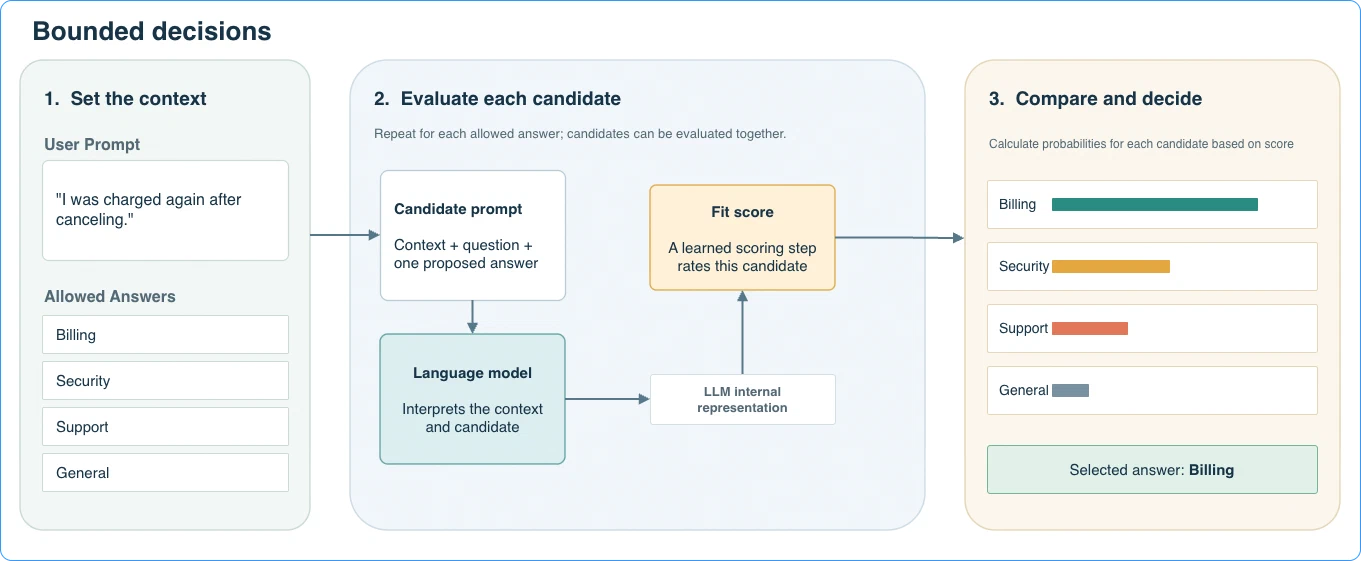
By eliminating the need for the language model to calculate output tokens, we can eliminate that overhead and get a fast decision with reduced computational cost.
General decision types
Since each question can return probabilities for its possible outcomes, this approach can support a variety of decision types.
Probability
A probability communicates the model’s relative preference in a machine-readable form. Given a set of options, this approach provides a probability for each one, normalized across the supplied choices. A higher value means the model favors that option over the others; it is not, by itself, a guarantee or calibrated measure that the answer is correct. With clear criteria, you get a set of probabilities that you can use to handle the data.
Choice
A bounded choice selects one value from a closed set such as billing, security, support, or general. It works well for routing because every valid answer maps directly to a known classification. The system returns probabilities for the options and selects the most likely value.
Binary decision
Since a binary decision evaluates one proposition, the system uses the candidate’s score to calculate probabilities for Yes and No. This makes it exceptionally fast and light.
Less (to say) is more
Open-ended generation is the right tool when the output is for a person or where the text output is actually the product (such as creating code or content). Decisions are different. Routing, relevance, risk assessment, and escalation usually just need a concise, structured output without any narrative.
You are using different parts of machine learning for the benefits each provides. The language model interprets the messy, open-ended user input, while the trained classifier scores the allowed answers. By combining these approaches, you can return a structured decision without generating a narrative response.